Drawdown: trailing, end of day and static
How Ink works out your drawdown floor and headroom for each drawdown type, with worked examples.
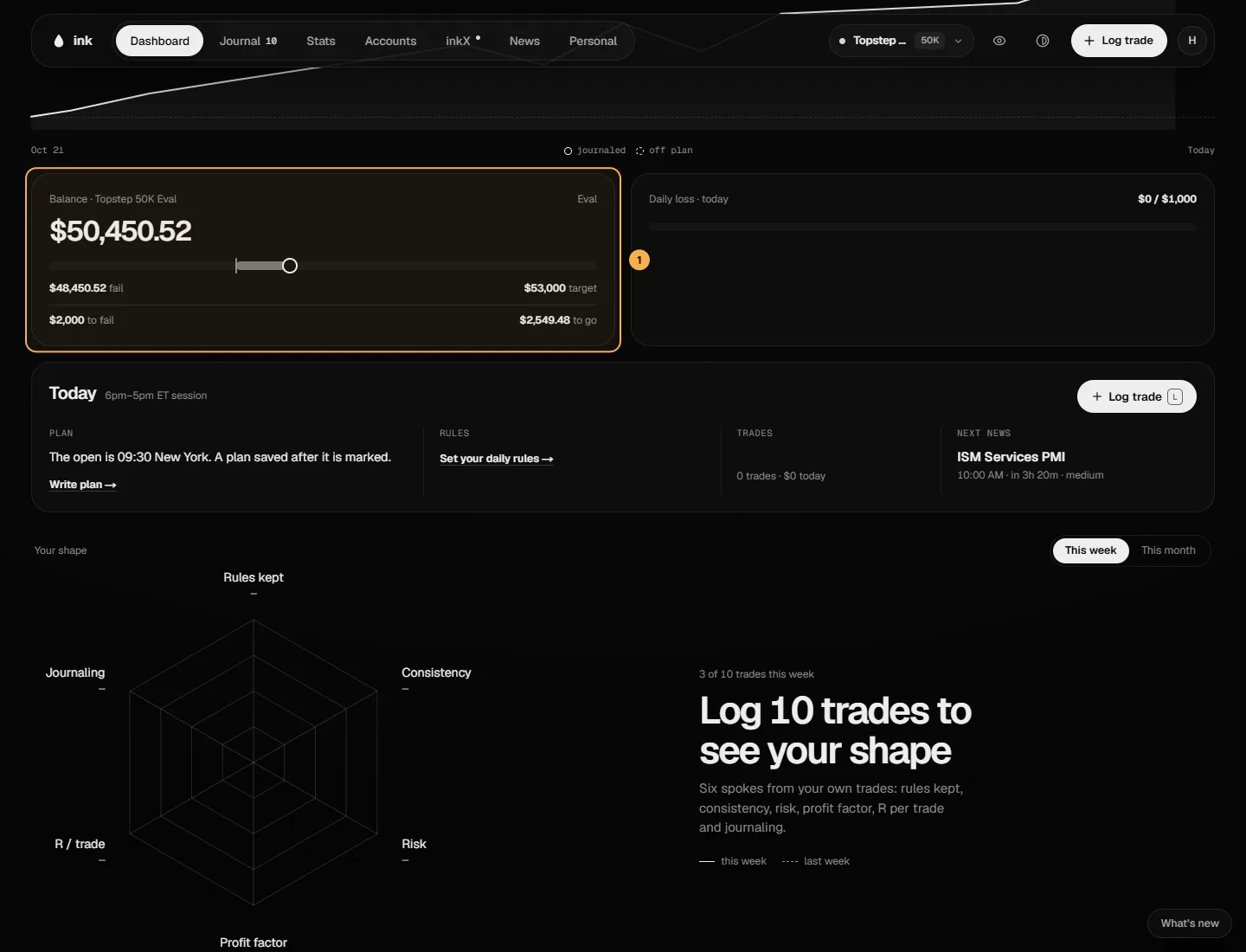
Every prop account has a max loss: if the balance falls to the floor, the account is done. The floor is the peak balance minus the max loss — what changes between drawdown types is which peak counts. Ink works this out in computeDrawdown (lib/pnl/prop-rules.ts) and shows it on the Dashboard's Balance card — the floor is the step line under your balance, and Room to max loss is the gap between them (the headroom):
- Floor — the balance you can't go to or below.
- Now — your balance by Ink's records: starting balance + prior P&L + net P&L of your trades − payouts.
- Headroom — Now minus the floor: how much you can still lose.
The account is marked "Max loss reached" when the balance is at or below the floor.
All the examples below are made up: a $50,000 account with a $2,000 max loss.
Static — the floor never moves
The floor is the starting balance minus the max loss, forever.
Example. Floor: $50,000 − $2,000 = $48,000. You make $1,000, then lose $500. Now: $50,500. Headroom: $50,500 − $48,000 = $2,500. The floor didn't follow you up, so headroom grows past the max loss.
End of day — the floor follows your closing balances
The peak is the highest balance at the close of a completed session (sessions start at 6pm ET for futures, 5pm ET for CFD). The session in progress never moves the floor: an up morning raises it only once the session ends at 5pm ET.
Example. Monday's session closes +$1,200 (balance $51,200), Tuesday's −$400 ($50,800). It's Wednesday and you're +$600 so far ($51,400). Peak: $51,200 (Monday's close). Floor: $51,200 − $2,000 = $49,200. Headroom: $51,400 − $49,200 = $2,200. When Wednesday's session closes at $51,400, that becomes the peak and the floor rises to $49,400.
Intraday trailing — an estimate
At an intraday firm, the floor follows your highest balance during trades, including open profit you didn't keep. Ink only sees closed trades, so it uses the highest balance after a closed trade. Your real peak can only be that high or higher, so your real headroom can only be that much or less. Ink shows it as "≤ $X … estimate".
Example. Three trades close +$800, −$300, +$200. Highest closed balance: $50,800, so the floor is at least $48,800. Now: $50,700. Headroom: ≤ $1,900 (estimate). If the first trade had been up $1,100 before you closed it at +$800, the firm's floor would be $49,100 and your real headroom $1,600.
Lock level — where the floor stops
Many trailing accounts stop trailing once the floor reaches a set level, usually just above the starting balance. In Ink, Lock level is in dollars above the starting balance (blank = never locks). Once locked, the card shows Floor (locked), and headroom can grow past the max loss.
Example. End of day, lock level $100 → the floor stops at $50,100. Two sessions close +$1,500 and +$600: peak $52,100, floor $52,100 − $2,000 = $50,100 — locked. Another session closes +$900: peak $53,000, but the floor stays at $50,100. Headroom: $53,000 − $50,100 = $2,900.
Payouts
A payout lowers your balance from the day it's paid; it doesn't lower the floor. If a firm instead resets the trail after a payout, its floor is lower than Ink's, so Ink never shows more headroom than you have.
With Payout locks the floor turned on (it needs a lock level), the first payout moves the floor straight to the lock level, wherever the trail had reached.
Example. End of day, lock level $0 (lock at $50,000). A session closes +$1,500: peak $51,500, floor $49,500. You take a $1,000 payout: Now $50,500.
- Without the payout lock: floor $49,500, headroom $1,000.
- With Payout locks the floor: floor $50,000, headroom $500.
A few firms measure the drawdown on gross profit, so a payout doesn't lower the balance the floor is checked against (TradeDay Quick Pay funded). For those, turn off Payouts lower the drawdown balance in the Drawdown section: the payout stays in the rule balance.
Example. 50K, $2,000 intraday trailing, the floor stops at $50,000. You make $3,000 (floor $50,000), take a $2,500 payout, then lose $600.
- Payouts lower the balance (most firms): Now $49,900 — breached.
- Payouts stay in the balance (gross profit): Now $52,400 — headroom $2,400.
The account picker's room for each account is this headroom (whole dollars, rounded down); an estimate shows as "≤ $X room".
Payouts come from what you log under costs and payouts — see Track costs and payouts.
Accounts you were already trading
If you start logging an account that already has profit, Ink can't see the peak it reached before. Choose Already trading when you add it and enter the Current max-loss floor from your firm's dashboard: Ink works the peak out from it (floor + max loss), and the floor is exact from day one. Leave it blank and Ink takes your balance when you joined as the peak, and marks the result an estimate.
Example. You join at $52,500, end of day, no lock level. Your firm shows the floor at $51,000: peak $51,000 + $2,000 = $53,000, headroom $52,500 − $51,000 = $1,500. Left blank, Ink would take $52,500 as the peak: floor $50,500, headroom $2,000 — an estimate.
With a lock level of $100 (floor stops at $50,100), a floor of $51,000 is past the lock, so the floor is locked at $50,100: headroom $2,400.
On an intraday account the floor still moves with open profit Ink can't see after you join, so it stays an estimate.
See Add an account you're already trading.
Presets last checked: Nov 2, 2026. (Apex on Oct 7, 2026; funded payout rules on Oct 24; everything else on Oct 23.) Always confirm current rules with your prop firm. Firms change them.